Your next customer will not type. Their AI will.
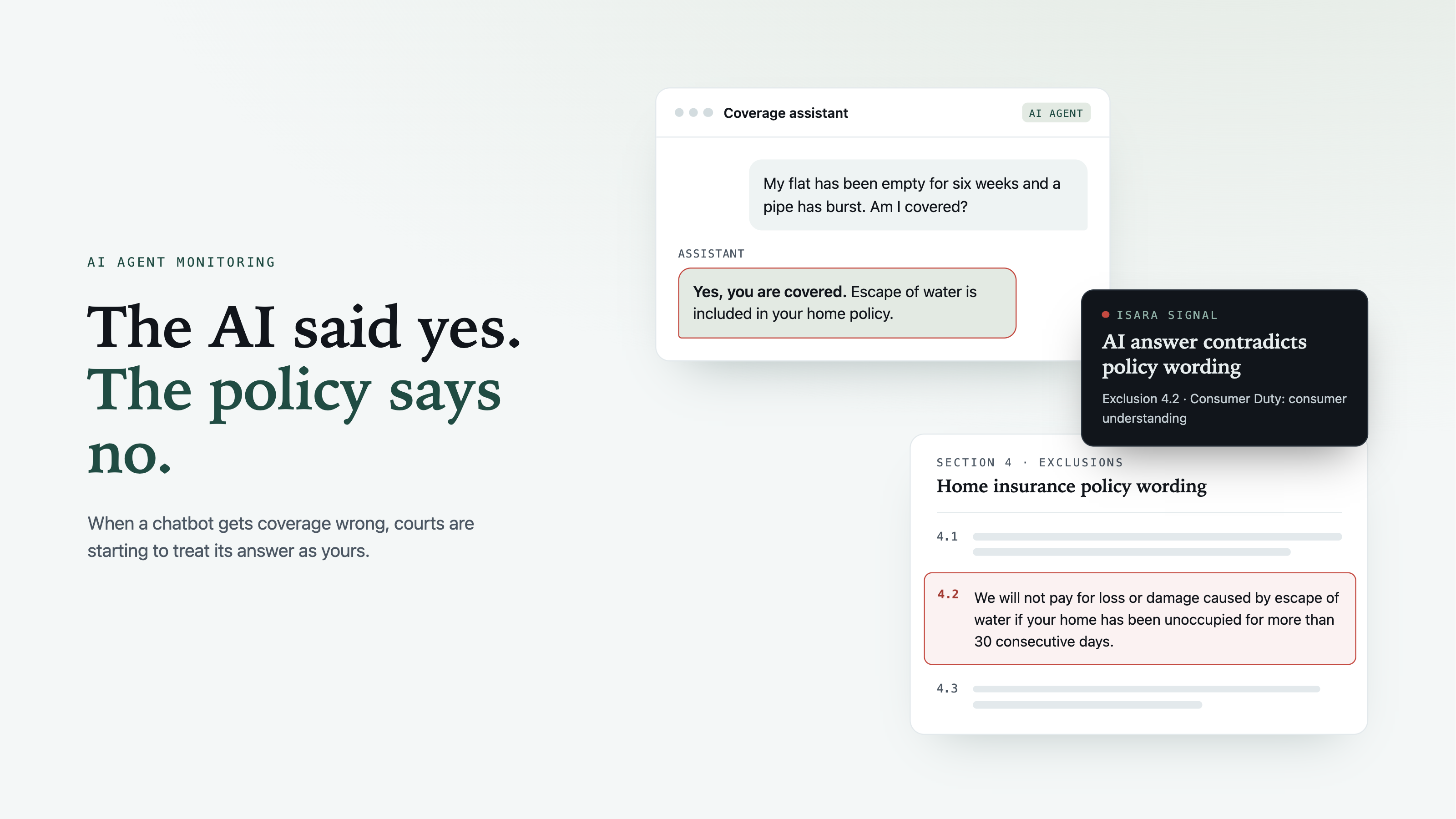
Your policyholder asked an AI if they were covered. The AI said yes. Your policy says no.
Key takeaways
- If your AI agent tells a policyholder they are covered, recent 2026 rulings suggest your business may be held to that answer, not the chatbot.
- Standard commercial general liability cover is being stripped of generative AI claims, so the real gap often sits in technology errors and omissions.
- Human quality assurance samples a fraction of conversations, which stops being representative at AI volume.
- Isara reads one hundred percent of customer conversations to surface AI agent failures and compliance exposure before they become claims.
The answer you did not want: you may be held to what the bot said
Start with the uncomfortable resolution. If your AI agent told a policyholder they were covered, and your policy says they were not, the direction of travel in 2026 is that the policyholder relied on your answer, and your business owns it. The chatbot is not a separate party that absorbs the mistake. Courts are beginning to treat its words as your words.
That single sentence reshapes how customer support and customer success teams should think about every automated conversation they run. The question is no longer whether your AI is helpful. It is whether you can see what your AI is actually telling customers, across every conversation, before a wrong answer becomes a claim or a complaint.
That blind spot is the exposure Isara was built to close. When an AI agent handles thousands of coverage questions a week, someone has to read the ones that go wrong, and human quality assurance only ever samples a sliver.
What two German courts just decided about your chatbot
For years the reassuring story was that a chatbot error was a glitch, not a liability. That story is now harder to tell.
In May 2026, two German courts moved within a fortnight of each other.
On 12 May 2026, the Higher Regional Court of Hamm ruled, in case 4 UKl 3/25, that a website chatbot is legally part of the business that runs it. Its invented statements are attributed to the operator even when the system was configured with care. This is reported as the first published German higher court decision on chatbot liability, and the court expressly allowed an appeal to the Federal Court of Justice because the core questions need settling.
On 28 May 2026, the Munich Regional Court I held Google directly liable for false statements produced by its AI answer feature. The reasoning was blunt: a company that designs, trains, operates and manages an AI system must take legal responsibility for the responses it generates. The ruling is preliminary and Google has said it will appeal, so treat it as direction rather than settled law.
The common thread matters more than any single judgment. Both courts treated the AI output as the operator’s own statement, not as third party content that benefits from a safe harbour. Read that across to insurance and the picture is plain. When your bot says “yes, you are covered,” a court may read that as your firm saying it.
The insurance market is already pricing this in.
As of 2026, insurers have been stripping generative AI claims out of standard commercial general liability cover. The Insurance Services Office introduced optional AI exclusion endorsements for commercial general liability policies, so coverage that used to respond to an AI error by accident is now being removed at renewal.
The policy that actually responds to a wrong answer is technology errors and omissions, also called professional liability, and even that is shifting form by form. Recent reporting notes that carriers including CFC and Beazley have added affirmative AI cover to their errors and omissions products, while specialist writers at Lloyd’s such as Armilla and Testudo have moved into standalone AI liability. The gap between what firms assume they carry and what their policy names is widening, not closing.
For regulated verticals the stakes rise again. In the UK, the Financial Conduct Authority has not written a separate AI rulebook. It has said that existing standards, including the Consumer Duty, continue to apply. Two of the Duty’s four consumer outcomes, consumer understanding and consumer support, map directly onto a chatbot that gives a confident but wrong answer about cover. A misquoted exclusion is not a technical fault in that frame. It is a conduct issue.
This is the layer where Isara operates. Isara reads every customer conversation, including the ones handled by AI agents, and flags the moments where an answer creates compliance exposure or contradicts the firm’s own position, so the error surfaces as a signal rather than as a lawyer’s letter.
The silent majority of AI conversations, and the readiness gap it creates
Here is the original observation that the legal and insurance coverage misses. The problem is not that AI agents sometimes give a wrong coverage answer. Every channel, human or automated, produces errors. The problem is visibility. A wrong answer from a human agent usually leaves a trail someone eventually reads. A wrong answer from an AI agent, at machine volume, mostly disappears into the transcript archive unseen.
Consider the shape of a typical support operation. Quality assurance reviews a small, hand picked sample, often only one or two conversations in a hundred. When humans handled the conversations, that sample was a rough proxy for the whole. When an AI handles tens of thousands of conversations, the same sample stops being representative and becomes close to meaningless. The nineteen hundred and ninety eight conversations nobody read are where the liability lives.
A short illustrative scenario makes the point. Picture an operator whose AI agent handles forty thousand coverage questions in a quarter. If even a fraction of one percent produce a confidently wrong “yes, you are covered,” that is still dozens of policyholders walking away with a false belief about their protection. Not one of those answers trips an alarm, because nothing in a standard support stack is reading all of them for correctness against the actual policy position. The first time most firms learn about the wrong answer is at the point of claim, which is the most expensive possible moment to find out.
So the real readiness question for a customer experience leader in 2026 is not “is our AI good.” It is three sharper questions.
- Can we see what our AI agents told customers across one hundred percent of conversations, not a sample?
- Can we detect, quickly, the specific answers that contradict our policy or our regulatory obligations?
- Can we prove to a regulator or an insurer that we monitor this, rather than hoping?
A firm that can answer yes to all three has turned an unfunded liability into a managed one. A firm that cannot is relying on luck and a safe harbour that the courts are quietly withdrawing. Isara exists to move firms from the second group to the first, by reading every conversation and turning AI agent failures into something a team can see and fix before it compounds.
The prediction worth holding is simple. Within the next renewal cycle or two, demonstrable conversation monitoring will stop being a nice to have and start being something insurers and regulators expect you to show. The firms that can evidence it will find both cover and audits easier. The firms that cannot will pay for the gap one way or another.
How Isara helps you catch the wrong answer first
How does Isara spot an AI agent telling a customer the wrong thing about cover?
This article is about the conversations you never read. Isara reads one hundred percent of your customer conversations, including those handled by AI agents, and surfaces AI agent failures and compliance exposure as signals, rather than leaving them buried in transcripts until a claim arrives.
We already run quality assurance. Why is that not enough for AI volume?
As the piece explains, sampling one or two conversations in a hundred made sense for human teams and breaks down at machine volume. Isara reviews every conversation instead of a sample, so the wrong “yes, you are covered” is caught in the population, not missed in the gap.
Can Isara help with regulated obligations like the Consumer Duty?
The regulatory section above notes that existing standards still apply to AI. Isara is built for regulated verticals, including financial services and iGaming, and flags conversations that create compliance exposure, giving conduct and compliance teams evidence that monitoring is happening rather than assumed.
Does Isara work with the tools we already use?
Without ripping anything out. Isara reads from the helpdesks CX teams already run, including Zendesk, Freshdesk, Intercom, HubSpot, Front and Gorgias, so the monitoring described in this article sits on top of your current stack.
Beyond catching errors, what else does reading every conversation give us?
The article focuses on liability, but the same full coverage view also surfaces churn risk and agent performance issues. Isara continues to extend its conversation intelligence so leaders can move from reacting to incidents toward spotting them early.