Your bot answered correctly. Their AI summarised it wrong. Who owns the outcome?
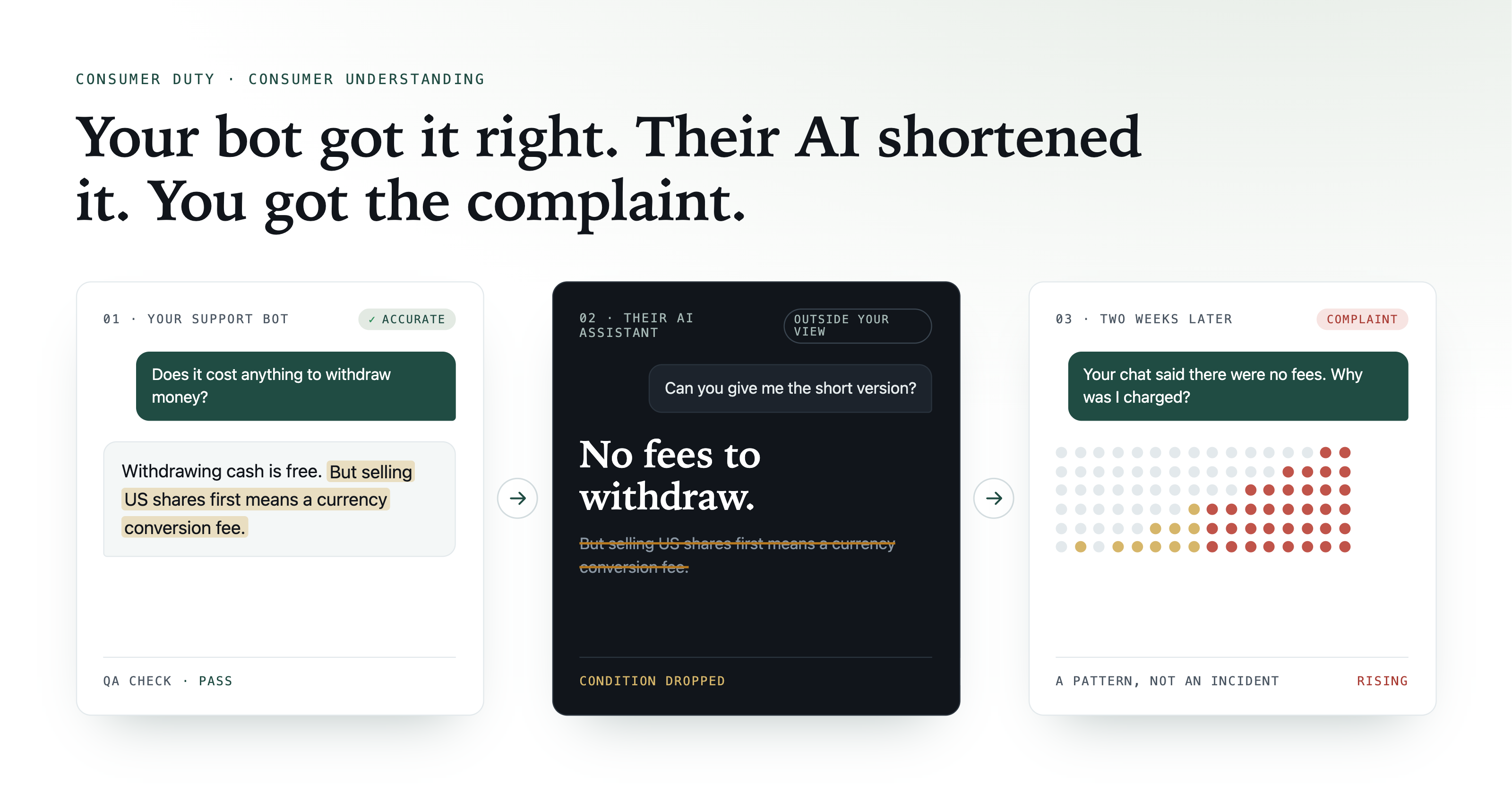
Your answer was right. The version your customer acted on was not.
A customer asks your support bot whether it costs anything to withdraw money. The bot answers correctly. Withdrawing cash is free, but selling US shares first means a currency conversion fee.
The customer pastes that answer into their own AI assistant and asks for the short version. The short version says there are no fees.
Two weeks later, the customer sees the fee and contacts you again. This time it is a complaint, and it quotes your own chat back at you.
Your quality checks will mark the first conversation as a pass. The bot followed its script and every fact was accurate. The problem only appears in the second conversation, and it only becomes clear when the same complaint arrives from many customers.
The takeaway for customer experience and compliance leaders at investment and trading platforms is simple:
- A correct answer is no longer the end of the journey. More and more customers pass it through a tool you do not control.
- The regulator has not said who owns that gap. It has said that firms must be able to evidence that customers understand.
- The evidence of misunderstanding usually arrives in your own support conversations. It shows up as a pattern, not as a single incident.
How customers now read your answers
For many retail investors, an AI assistant now sits between your answer and their decision. The FCA has been measuring this closely in 2026.
What the FCA has found this year
- Trust is high. FCA research published on 27 August 2026 found that 56% of 18 to 40 year olds who invest, or are thinking about it, trust AI tools more than TV and radio, the press or social media influencers.
- Protection is misunderstood. The same research found that 44% wrongly believe AI generated financial information is regulated, and 32% wrongly think they would be compensated by the Financial Services Compensation Scheme or the Financial Ombudsman Service if AI advice went wrong. The FCA states plainly that general purpose AI chatbots are not regulated.
- Use is widespread. In a speech on 19 October 2026, the FCA's Jessica Rusu said four in five less experienced investors aged 18 to 40 have used AI when investing. She added that only 40% of consumers correctly recognise there is no recourse if something goes wrong.
Evidence from the US points the same way. PensionBee's 2026 AI and Your Money Report, a survey of 1,000 US adults who use chatbots for personal finance, found that 23% had received incorrect financial information and 57% would act on AI guidance without checking it, as reported in September 2026.
This is not a story about bad assistants
Summarising is exactly what customers ask these tools to do. A summary is shorter than the original by design, so something always gets left out.
The FCA's own response reflects this. It has not blamed AI providers. It has asked them, on a voluntary basis, for "clear, proportionate and consistent disclaimers" at the point where financial information is delivered.
What tends to get lost in a summary
In our experience, the facts usually survive. The conditions around them are what disappear. Support teams at investment platforms will recognise these shapes:
- The exception. "Withdrawals are free, unless you need to convert currency first" becomes "withdrawals are free".
- The sequence. "You can withdraw once your sale has settled" becomes "you can withdraw today".
- The account type. "Your ISA is not flexible, so money you take out and put back counts towards this year's allowance" becomes "you can take money out and put it back".
- The tier. "This rate applies to balances above a set amount" becomes "you will get this rate".
In each case, your bot gave the right answer. The customer acted on a different one.
So who owns the outcome?
The honest answer is that nobody has settled it yet. There are three parties in the journey, and the rules treat each of them differently.
The assistant
General purpose AI chatbots are not regulated by the FCA. Advice from them is not covered by the Financial Ombudsman Service or the Financial Services Compensation Scheme. A customer who acts on a faulty summary has no route to redress against the tool that wrote it.
The customer
UK financial services law includes the general principle that consumers should take responsibility for their decisions. That principle still applies. It has never meant that a firm can ignore what it knows.
The firm
Under the Consumer Duty, consumer understanding is one of the four outcomes. Firms must make sure communications meet customers' information needs, are likely to be understood, and equip customers to make decisions that are effective, timely and properly informed. They are also expected to test, monitor and adapt those communications where they are not working.
The Duty also requires firms to avoid causing foreseeable harm. FCA guidance, as summarised by Browne Jacobson, judges this against "what a firm knows, or could reasonably be expected to have known".
The Mills Review, published by the FCA on 6 July 2026, adds the AI dimension. It warns that AI journeys make it harder for firms to evidence that consumers genuinely understand products, and it expects outcomes to be evidenced through continuous monitoring rather than point in time checks.
The Financial Ombudsman Service is asking the same question. In its response to the Mills Review in April 2026, it asked the FCA for clarity on how disputes should be handled when a consumer's AI interacts directly with a firm's chatbot.
Our reading
This is not legal advice, and the position will keep developing. But the direction is clear enough to act on.
A firm is unlikely to be held responsible for one summary it never saw. It becomes much harder to call the harm unforeseeable once the same misunderstanding has appeared in hundreds of the firm's own support conversations. At that point, the question shifts from who caused the error to who could see it.
The customer's assistant will often help write the complaint too. The Financial Ombudsman Service reported in March 2026 that up to a third of responses to its initial assessments, in a small sample, appeared to be generated or heavily assisted by AI. When that complaint arrives, the firm that has read its own conversations is in a far stronger position than the firm that has not.
The pattern, not the incident
One customer who misread a fee is an incident. Your team will answer it, apologise and move on. Two hundred customers who misread the same fee in the same way is a pattern, and it usually points to something you can fix.
The mistake that repeats perfectly
When a bot gives an answer that is accurate but easy to summarise wrongly, it gives that same answer to every customer who asks. The fault is not random. It repeats perfectly, thousands of times, and every individual conversation still looks like a pass.
That is why checking whether the bot followed its script is not enough. Isara assesses what customers understood, not whether the bot said the right words. It reads the follow up conversations where misunderstanding surfaces, and groups recurring fee or withdrawal confusion into a single pattern with its volume, its trend and the date it started.
An illustrative model
The numbers below are hypothetical. They show how the analysis works, not what any real platform sees.
Imagine a trading platform that adds US shares to its app. Its bot explains the currency conversion fee correctly, but only in the second sentence of its answer about withdrawals. Over the next six weeks:
- 210 customers contact support about an unexpected fee on a withdrawal.
- 130 of them refer to an earlier answer, with phrases like "your chat said there were no fees" or "I was told withdrawals are free".
- 40 say they checked with an AI assistant before acting.
- The pattern starts in the week the US shares launch, and grows each week after that.
- Almost all of it sits in one cohort: customers who hold US shares and withdraw in pounds.
Three things stand out in a model like this:
- The start date tells you the cause. The pattern lines up with a product change, not with a change in customer behaviour. That points straight at the answer that needs rewriting.
- The source matters less than you think. Whether the summary came from an assistant or from a customer skim reading, the fix is the same. The answer has to survive being shortened.
- It is invisible in a sample. If a team reviews 2% of conversations, it would read around four of those 210. That looks like four unlucky customers, not a design problem.
Writing answers that survive a summary
The FCA's review of consumer understanding, published in March 2026, highlighted firms that put essential information, risks and exclusions early. The same habit helps an answer survive an AI summary:
- Put the condition first. "If your shares are in dollars, you will pay a conversion fee before you withdraw" is harder to lose than a fee mentioned at the end.
- Use one fact per sentence, so a shorter version cannot merge two of them.
- Name the account type, product or tier the answer applies to.
- Then watch whether the pattern falls. A rewrite that does not reduce the confusion has not fixed it.
What this does not prove
Isara cannot see a customer's conversation with their own assistant. A customer who says "my assistant told me" may be remembering it wrongly, and a customer who says nothing may still have used one.
What the analysis does show is that a misunderstanding recurs, in which cohort, at what volume and since when. That is the evidence a firm needs to decide what to change, and to show later that it was looking.
Three questions to ask your own data this week
- Which fee or withdrawal question did your team answer most often last month, and is it rising?
- How many complaints quoted an earlier answer from your own bot or team?
- When you last changed a product or price, how long did it take you to see the confusion it caused?
Frequently asked questions about Isara and consumer understanding
Can Isara see what a customer's own AI assistant told them?
No. Isara reads the conversations in your helpdesk, including Zendesk, Freshdesk, Intercom, HubSpot, Front and Gorgias. Customers often mention what they were told elsewhere in their own words, and Isara picks that up across 100% of conversations rather than a sample.
How does Isara spot a misunderstanding when the bot answered correctly?
Isara assesses what the customer understood, not only whether the bot followed its script. It groups recurring confusion, such as a fee customers keep missing, into one pattern with volume, trend and start date.
Does Isara score our bot and our human agents in the same way?
Yes. Agent Intelligence scores every reply from 0 to 100, whether it came from a person or an AI agent, so you can compare both against one standard.
Can I ask about a specific fee or product?
Yes. You can put a plain English question to Ask Isara, such as "Which fee questions increased after the US shares launch?" Custom Filters let you narrow the results by product, account type or any other field your helpdesk holds.
How quickly will my team see a new pattern?
Pulse surfaces changes in real time, so a rise in confusion after a product or pricing change does not wait for the monthly review. Scheduled reports can send the same view to your compliance and leadership teams every week.
Does this help with Consumer Duty evidence?
It supports it. The FCA's March 2026 review highlighted firms that used chat transcripts and complaints as sources of insight into consumer understanding. Isara's Compliance Audits review 100% of conversations against the rules you set, so you can show how customers were informed and where understanding broke down.
What is coming next?
Isara is rolling out feedback on every signal, so your team can confirm or correct what it flags. That feedback will power an AI calibration section that suggests better instructions, with versioning so you can compare versions and see whether a change made a difference.